Texas Pre-Foreclosure Pipeline Reaches 24,672 Active Filings, Signaling Distressed Inventory
Over the past 12 months, Texas has registered 24,672 active pre-foreclosures, placing it second in the nation for properties in distress and signaling a significant pipeline of potential investment opportunities.
Texas is a focal point for housing market distress in the United States, with a substantial volume of properties currently navigating the pre-foreclosure process. Over the last 12 months, the state has accumulated 24,672 active filings affecting 26,481 individual parcels, according to BatchData's Active Pre-Foreclosures Report. This positions Texas as the #2 state in the country for pre-foreclosure activity, accounting for a notable 8.6% of the national total of 286,910 filings. The state's activity far surpasses the national per-state average of 5,738, underscoring its significant role in the national landscape of distressed real estate.
The vast majority of these filings are concentrated in the residential sector, which comprises 22,524 properties, or 91.3% of the state's total. An analysis of the pipeline's stages reveals a market where properties are overwhelmingly close to resolution. A staggering 73.3% of active cases are at the Notice of Sale stage, the final step before a potential auction. This suggests a large volume of inventory may soon be available to investors, creating a dynamic environment for those focused on acquiring distressed assets.
What's Driving the Texas Pre-Foreclosure Market
The state's high volume of pre-foreclosures is not uniformly distributed. Instead, it is heavily concentrated in its largest metropolitan areas. Furthermore, the composition of the pipeline, both in terms of foreclosure stage and property type, reveals critical trends for understanding where opportunities and risks lie for real estate investing. The data points to a market defined by late-stage distress primarily affecting single-family homes in major urban centers.
Geographic Hotspots: Activity Centers on Major Metros
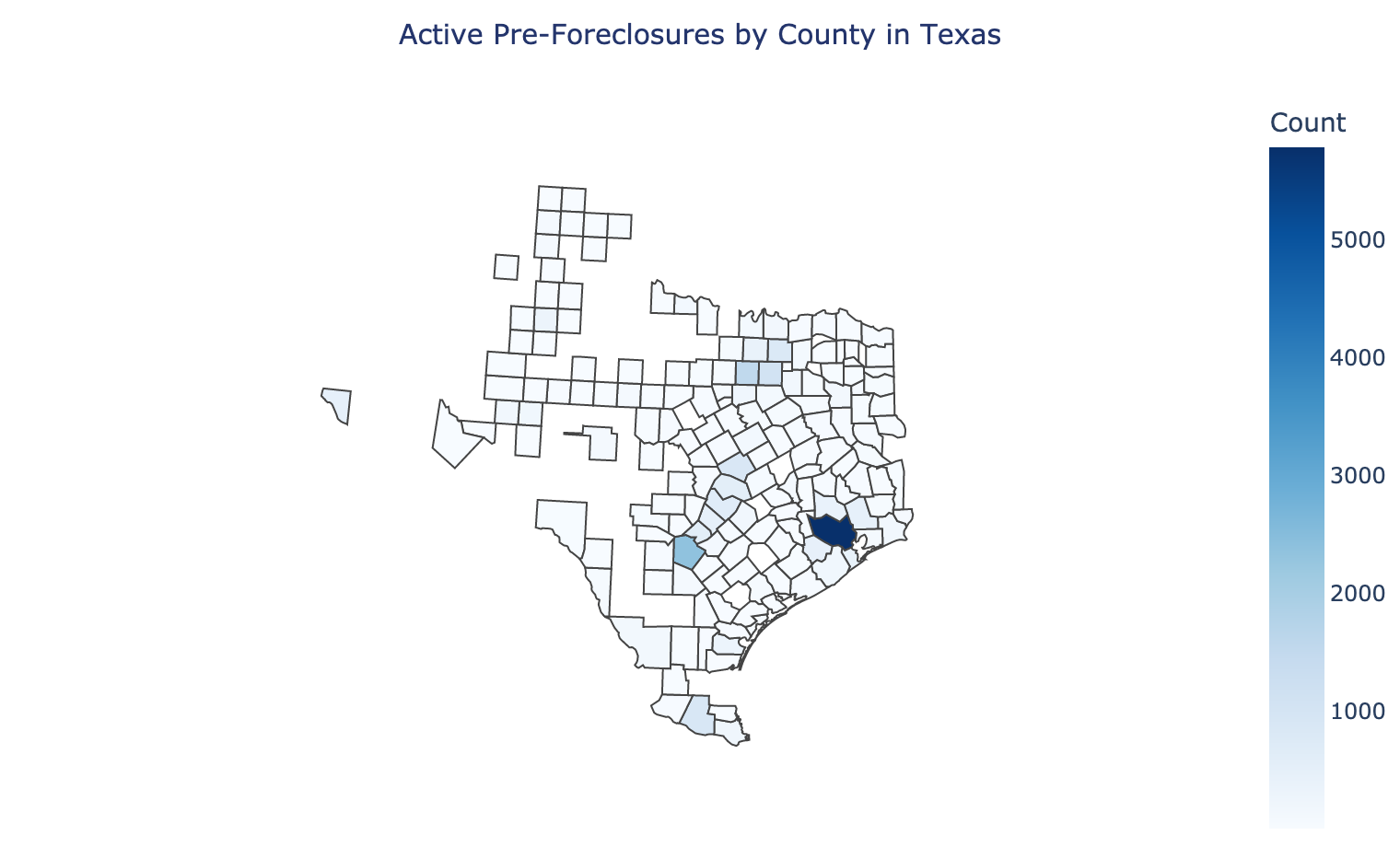
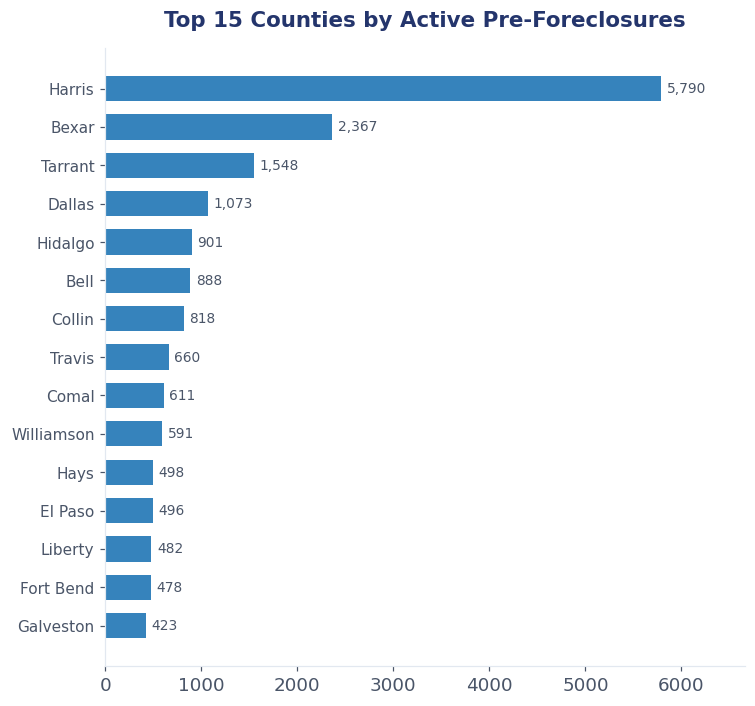
Pre-foreclosure activity in Texas is overwhelmingly clustered around its primary population and economic hubs. Harris County, home to Houston, leads the state by a wide margin with 5,790 active pre-foreclosures. This single county represents a substantial portion of the statewide total, making it the epicenter of distressed activity. Following Harris County is Bexar County (San Antonio), with 2,367 filings, solidifying its position as another key market for investors to watch.
The Dallas-Fort Worth metroplex also shows significant signs of distress, split across its major counties. Tarrant County (Fort Worth) ranks third with 1,548 active cases, while Dallas County follows with 1,073 filings. Rounding out the top five is Hidalgo County in the Rio Grande Valley, which reports 901 pre-foreclosures, indicating that housing distress extends beyond the state's largest urban cores. Other counties with significant activity include Bell County (888), the Austin-area counties of Travis (660), Williamson (591), and Hays (498), and the Dallas-suburb of Collin County (818). This concentration in and around major cities reflects where the bulk of the state's housing stock is located, but the high numbers point to specific pockets of economic strain. In contrast, dozens of rural counties show minimal activity, with areas like Crosby, Frio, and McCulloch each reporting only a single pre-foreclosure filing over the past year. This stark divide highlights the importance of localized data for identifying viable investment targets.
A Pipeline Heavily Weighted Toward Auction
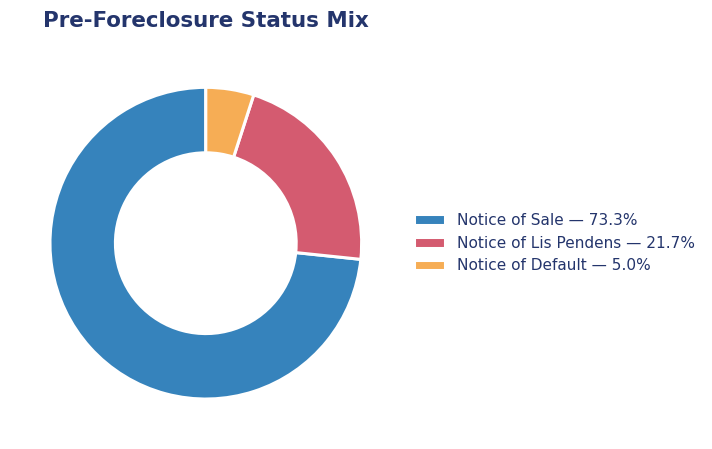
A critical insight from the data is the maturity of the state's pre-foreclosure pipeline. An overwhelming majority of properties, 18,096 in total, are at the Notice of Sale stage. This accounts for 73.3% of all active pre-foreclosures in Texas. This late-stage concentration indicates that these properties are nearing a foreclosure auction, presenting an imminent wave of inventory for investors who specialize in acquiring assets at this point. It suggests that many homeowners in the pipeline have exhausted earlier options to cure their default, and the properties are now poised for a change in ownership.
In contrast, the earlier stages of the process represent a much smaller share of the total. The Notice of Lis Pendens, which formally marks the beginning of a foreclosure lawsuit, accounts for 5,349 properties, or 21.7% of the pipeline. The initial stage, the Notice of Default, is the smallest segment, with just 1,227 properties, representing only 5.0% of the total. This top-heavy distribution suggests that investors have a narrower window for early-stage interventions, such as short sales or loan assumptions, and a much larger pool of opportunities at or near the auction block. For those with the capital and expertise to navigate auctions, the Texas market currently offers a significant volume of potential acquisitions.
Residential Properties Dominate the Distressed Landscape
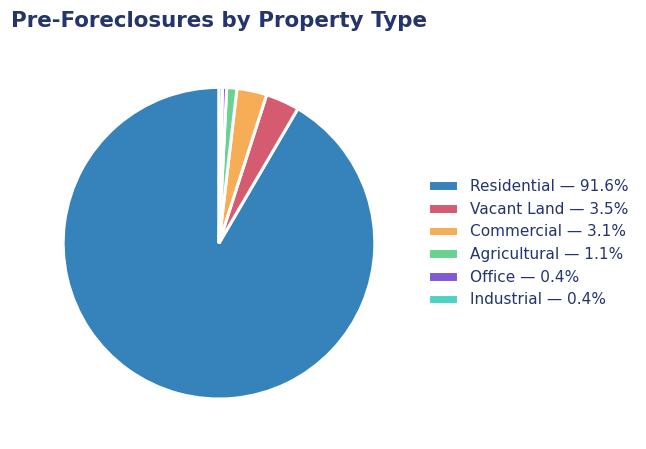
The distress in the Texas housing market is almost entirely concentrated within the residential sector. Residential properties account for 22,524 filings, or 91.3% of the statewide total. Within this category, Single-Family homes are the most affected asset class by a substantial margin. A total of 19,231 single-family residences are in pre-foreclosure, making up 77.9% of all filings in the state. This underscores that the financial strain is most acutely felt by individual homeowners and "mom-and-pop" landlords.
Other residential property types also contribute to the total. Mobile and Manufactured Homes represent a notable niche, with 1,007 properties in pre-foreclosure, or 4.1% of the total. Condominium Units add another 463 filings (1.9%), while smaller multi-family properties like Duplexes (202) and Apartments (169) also appear in the data. While smaller in number, these categories offer specialized opportunities for investors. Beyond residential, Vacant Land accounts for 860 filings (3.5%), and Commercial properties make up 763 filings (3.1%). Other categories like Agricultural (260), Office (105), and Industrial (88) properties also show signs of distress, though at a much smaller scale.
Investor Takeaways
The Texas pre-foreclosure landscape presents a clear and immediate opportunity for savvy investors, but one that requires speed, geographic focus, and access to precise data. The market is defined by a large, late-stage pipeline concentrated in the state's most populous counties, offering a target-rich environment for those prepared to act quickly.
The most compelling takeaway is the 18,096 properties currently at the Notice of Sale stage. This figure represents a significant supply of distressed assets that are on a direct path to foreclosure auction. For investors who purchase at the courthouse steps or acquire properties as REOs, this is a clear signal of impending inventory. This late-stage weighting means the timeline from identification to acquisition is compressed, favoring investors who have their financing and due diligence processes streamlined.
Given the geographic concentration, an effective strategy requires a targeted approach. Harris County, with 5,790 filings, is a market unto itself, offering enough volume for large-scale and small investors alike. The combined activity in Tarrant, Dallas, and Collin counties provides a deep well of opportunities across the Dallas-Fort Worth metroplex. Investors seeking less competition might look to markets like Bexar County (2,367) or Hidalgo County (901), which offer substantial volume outside the state's most competitive arenas. Pinpointing these opportunities requires granular data, which can be obtained through a property search platform or integrated directly into operational workflows via a property data API.
While single-family homes (19,231) are the dominant play, niche opportunities abound. The 1,007 Mobile/Manufactured Homes, 763 Commercial properties, and 169 apartment buildings in pre-foreclosure provide avenues for specialized investors to acquire assets at a potential discount. These alternative asset classes often face less competition than traditional single-family homes.
Success in this environment hinges on access to timely and accurate pre-foreclosure data. With 73.3% of properties in the final stage, the window to contact a homeowner, perform due diligence, and prepare for an auction is short. Investors need reliable information to identify opportunities as they arise and obtain correct owner contact details through services like skip tracing to engage with homeowners before the property is lost to the bank. The current market dynamics in Texas favor the prepared investor who can leverage data to move decisively.